AI is changing OTA economics and your margins. As OTAs use AI to buy traffic smarter and convert more efficiently, their own cost per acquisition falls while commission-heavy bookings can quietly erode hotel profitability if you don’t rebalance your mix.
AI for Hotel Profitability
Why AI in OTAs matters for hotel profitability
Online travel agencies are racing to embed artificial intelligence into every part of the booking journey – from search and pricing to review summaries and trip planning.
For Irish independent hotels and European city properties, this can feel like the unfortunate start of a new wave of OTA dependency. Yet the same AI shift that could make OTAs more powerful can also help hotels finally understand and reduce their true cost per acquisition (CPA).
CPA for Hotels
What is the “true cost per acquisition” for a hotel?
The cost per acquisition is more than just OTA commission. It includes every euro you spend to win a booking:
-
Direct Commission
-
Pay-per-click Media, and Metasearch spend
-
Discounts & Loyalty perks
-
Operational effort linked to a channel
When independent hotels actually map this out by channel, many discover that heavy OTA reliance quietly erodes margin, while well-optimised direct bookings can deliver significantly higher profit per stay due to lower overall CPA.
AI changes OTA Economics
How AI is changing OTA economics
OTAs are using AI to buy traffic more efficiently, to personalise ranking, and to convert lookers into bookers at scale. AI models analyse millions of searches and booking patterns to decide which hotels to feature, which rates to highlight and which messages to show each user.
That means OTAs can often reduce their own marketing cost per booking while preserving commission levels improving their economics even as hotels carry most of the cost. For independent hotels that could already be seeing 50–60% of business via OTAs, that combination of algorithmic control and high effective CPA is a serious long-term risk.
How hotels can fight back
How hotels can use AI to lower cost per acquisition
The good news is that AI is no longer reserved for global platforms. Irish and European city hotels can now apply similar intelligence to their own distribution strategy, bringing even more optimisation to the direct channel and lowering CPA.
1. Smarter pricing and channel mix
AI-driven revenue tools can analyse demand, pace and competitor rates to recommend the right price and the right channel at any given moment. This helps hotels protect rate integrity on OTAs while steering more demand to direct channels where CPA is lower.
2. Higher direct conversion on your website
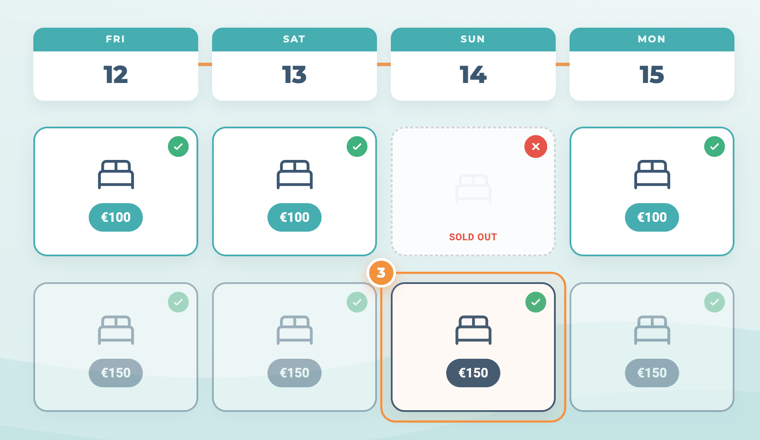
On hotel websites and booking engines, AI can simplify room selection, surface the most relevant offers for each user and answer common questions instantly. Bookassist’s AI Booking Platform is already doing this through personalised Rate Recommender technology with quite spectacular conversion improvement results.
Irish and European properties using AI-enhanced booking journeys are already reporting double-digit growth in direct bookings and less friction at checkout.
3. Using first-party data to reduce future CPA
Direct guests leave a trail of first-party data: search behaviour, booking history, preferences and spend. AI can unify this information into actionable profiles, allowing GMs and revenue leaders to focus marketing on high-value segments and repeat guests.
Over time, this lowers average CPA because you are spending less to acquire customers who are more likely to return direct.
From threat to opportunity
| Pressure point |
Risk if ignored |
Opportunity if addressed |
| Channel mix |
Over-reliance on high-cost intermediary demand. |
Use OTAs for reach, then rebalance toward more profitable direct business. |
| Website conversion |
Over-reliance on high-cost intermediary demand. |
Use AI-enhanced booking flows, personalisation and better merchandising. |
| Revenue strategy |
Poor pricing discipline weakens margin and ranking. |
Apply AI-supported pricing to protect rate integrity and improve net RevPAR. |
| First-party data |
Hotels keep renting demand instead of building loyalty. |
Turn guest data into lower future CPA and higher repeat value. |
Practical Steps for European City Hotels
To turn AI and OTAs into an opportunity rather than a threat, decision makers should:
1. Measure true CPA by channel, including commission, media costs, discounts and admin time.
2. Invest in AI-ready direct channels fast, mobile-first websites and booking engines that use AI for pricing, recommendations and personalisation. Bookassist Web Design already personalises the customer journey and Bookassist AI Booking Platform personalises offers to improve relevance and reduce booking friction.
3. Use OTAs for acquisition, not loyalty, and apply AI-powered CRM to convert OTA guests into profitable direct repeaters.
4. AI will certainly make OTAs more efficient, but it can also be the lever that finally allows independent hotels to see, manage and reduce the real cost of acquisition. For GMs and revenue managers willing to act now, the AI era can mean stronger margins, not weaker ones.
FAQ: AI, OTAs and Hotel Cost Per Acquisition
1. How can a small independent hotel start using AI without a big budget?
Begin with tools that plug into your existing stack: an AI‑enhanced booking platform, revenue management add‑ons or marketing automation that uses AI for segmentation and messaging. Focus on one or two use cases that clearly support more direct bookings or better pricing, then reinvest the incremental profit into further AI initiatives.
2. Can AI help me negotiate better terms or improve visibility on OTAs?
Indirectly, yes. When your pricing, availability and content are disciplined and data-driven, your performance on OTAs usually improves. Strong performance gives you more leverage in discussions around visibility programmes and commissions. AI data analysis can also highlight where OTA participation is genuinely accretive versus where you might be over‑exposed.
3. How often should I review CPA by channel and how can Bookassist help?
At minimum, quarterly and monthly if you are in a competitive city market. Regular reviews help you spot when OTA costs creep up through added programmes or discounts, and whether your direct efforts are really improving net profit per booking.
Bookassist supports this with analytics and reporting that bring together performance by channel, so GMs and revenue managers can clearly see where CPA is rising, where direct is winning, and where to adjust their distribution mix to maximise net RevPAR.
4. Will AI search and answer engines make my direct website less important and what is Bookassist’s role?
Not if you prepare correctly. AI assistants still need a trusted source of truth, and your website can/should be that source. Clear structure, rich content, FAQs and real-time offers help both humans and AI systems understand your property and present it accurately.
Bookassist’s AI Booking Platform and AI-enabled Website Design solutions are crafted to make hotel content relevant, fast, machine-readable and conversion-focused, so when guests or AI agents come looking, they find a direct experience that is compelling, easy to book and therefore more likely to convert - meaning more profitable for the hotel.