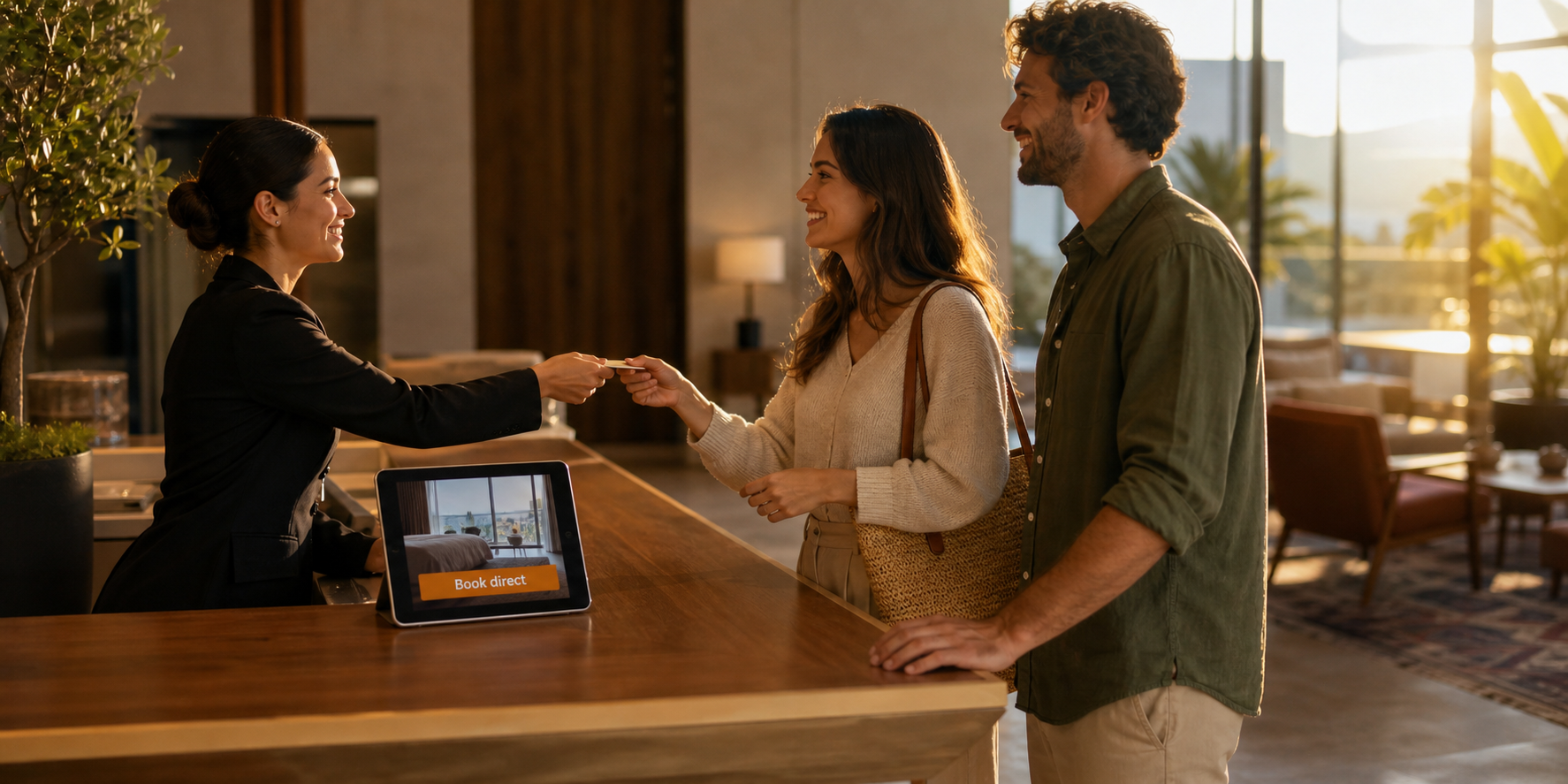
In short: a direct booking is a reservation a guest makes on your own hotel website, through your own booking engine, instead of through an OTA. Every booking that comes direct saves the OTA commission, typically 15 to 25 percent, and gives you the guest's details so you can welcome them back. To grow direct bookings, you need three things working together: a booking engine that converts, visibility where guests compare prices, and clear reasons to book with you rather than with a third party.
Online travel agencies are part of almost every hotel's distribution, and they do a useful job of putting your rooms in front of people who have never heard of you. The trouble starts when they become the default route for guests who already know you, who found you on Google, looked at your website and then went off to book the same room somewhere else. Those are the bookings that cost the most to give away, because you have already done the work of attracting the guest. This guide looks at why direct bookings for hotels matter so much, eight practical ways to increase them in 2026, the part your booking engine and metasearch play, and how to measure whether it is all working.
Why Direct Bookings Matter for Hotels
The most obvious reason is margin. When a guest books through an OTA, the hotel usually pays a commission of 15 to 25 percent on the value of the stay. On a €150 room for three nights, that means roughly €67 to €112 leaving the business on a single booking. When the same guest books direct, you pay for your booking engine and your marketing, but the cost per booking is usually far lower, and it is a cost you control rather than a percentage set by someone else.
The less obvious reason is the relationship. An OTA booking often arrives with limited guest information, and the OTA has every interest in bringing that guest back to its own platform next time. A direct booking gives you the guest's email address, their preferences and their history with you, so you can send a proper pre-arrival message, offer an upgrade, and invite them back the following year. Over time, a hotel that owns its guest relationships depends less on any single channel. If you want to see where third-party dependence can catch you out, our article on 10 OTA risks to watch for in 2026 covers the main ones.
| |
Direct booking |
OTA booking |
| Cost per booking |
Booking engine and marketing costs you control |
Commission, typically 15 to 25% |
| Guest data |
Yours, with full contact details |
Limited, mostly held by the OTA |
| Upselling |
Your add-ons, meal plans and upgrades |
Limited to what the OTA offers |
| Repeat business |
You can invite the guest back |
The OTA markets to the guest next time |
8 Ways to Increase Direct Bookings
There is no single trick that moves guests from OTAs to your website. What works is a series of small improvements, each removing a reason to leave or adding a reason to stay. Here are the eight that tend to make the biggest difference.
1. Make booking direct fast and easy on mobile
A large share of hotel searches now starts on a phone, and a guest on a phone has very little patience. If your booking engine is slow to load, hard to read on a small screen or asks for too much information at checkout, the guest will go back to the OTA app they already have installed. Test your own booking journey on a phone, from the homepage to the confirmation, and count the steps. Every field or screen you can remove makes it more likely that the booking finishes on your website.
2. Show guests why booking direct is better
Many guests assume the OTA price is the best price, so tell them otherwise, clearly and at the right moment. A best rate guarantee, free breakfast, a welcome drink, flexible cancellation or late checkout for direct bookers all give guests a concrete reason to stay on your site. The key is to show these benefits inside the booking journey, not just on a separate page. Bookassist's booking engine displays up to three Unique Selling Points as guests book, translated automatically into every language you sell in.
3. Show each guest the rates they are most likely to book
A long list of rates that all look alike is one of the most common reasons guests leave to "think about it". Personalising what each guest sees first solves much of that. The Rate Recommender in the Bookassist booking engine uses AI to surface the three most relevant rates for each guest, and hotels using it see a 20% improvement in booking conversion rate.
4. Do not lose bookings on sold-out nights
If one night of a longer stay is full in the room type a guest wants, many booking engines simply show "no availability" and the guest goes to an OTA that can still sell them something. Intelligent Room Substitution fills that gap with a superior room, invisibly to the guest, so a booking you would have lost stays on your website.
5. Offer what OTAs cannot
Your website is the one place where you can sell the whole experience, not just the room. Spa treatments, dining packages, meal plan upgrades, airport transfers and local experiences can all be offered during checkout. They raise the value of each booking, and they give guests a reason to choose your website, because the same package is not available anywhere else.
6. Protect your hotel's name in search
When someone searches for your hotel by name, they have already chosen you. If an OTA's ad appears above your own website for that search, you can end up paying commission on a guest who was looking for you all along. Brand protection campaigns on Google Search and Google Hotels make sure your official website is the first thing those guests see.
7. Bring past guests back
Your previous guests are the easiest people to win a direct booking from, because they already know and like your hotel. Keep in touch with a short, well-timed email programme, offer them a returning guest rate or a member-only benefit, and make sure every link in those messages goes straight to your booking engine. This is where owning the guest relationship starts to pay back.
8. Keep your Google presence and reviews up to date
Guests check your Google Business Profile, your photos and your reviews before they decide where to book. Make sure your profile has current information, good photography and a direct booking link, and reply to reviews in a way that shows you care about the stay. A guest who feels confident about your hotel is far more likely to book direct than one who is still unsure.
The Role of Your Booking Engine
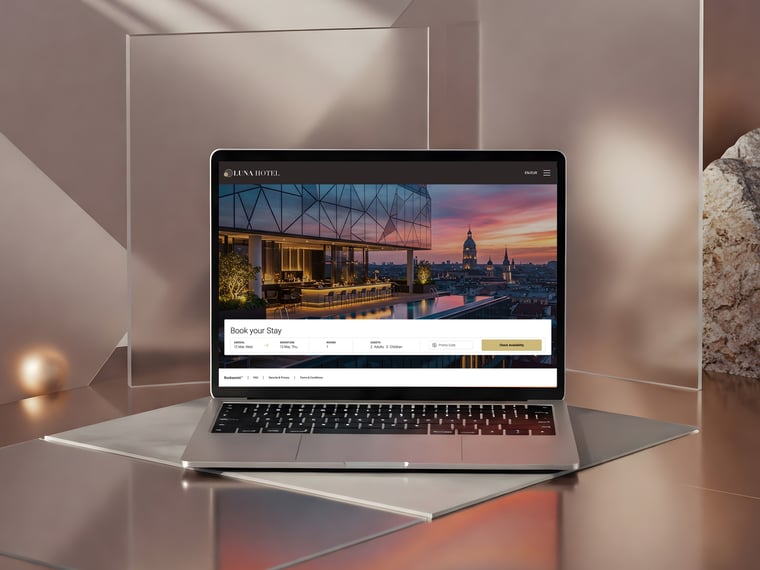
Most of the ideas above end in the same place: your booking engine. You can spend a great deal on advertising and still lose the guest in the last few clicks if the booking engine is slow, confusing or looks like a different website. That is why the booking engine deserves to be treated as a conversion tool rather than a piece of back-office software. It should carry your branding from the first click to the confirmation, personalise the rates each guest sees, handle sold-out nights intelligently and make it easy to add extras.
It is also worth knowing what good looks like. Engaged Bookassist clients frequently see conversion rates above 15% on their booking engine, and the results show up in direct revenue. The easyHotel Group, with 50 hotels across Europe, saw a 40% increase in direct bookings, and Aparthotel Puerto Azul in Marbella grew its direct share by 19% year on year. If you are not sure what an internet booking engine should be doing for you, our guide What Is an Internet Booking Engine (IBE)? goes through the features that matter most.
Metasearch and Google Hotel Ads
Millions of travellers compare hotel prices on metasearch sites before they book. Platforms such as Google Hotel Ads, Tripadvisor, Trivago, Kayak and Skyscanner show your rate side by side with the OTAs, which makes metasearch the place where a direct booking is either won or handed over. If your official rate is not there, the guest only sees the OTA prices and books through one of them.
Being present is only the start. You need your booking engine connected to the metasearch feeds so that the price shown is always accurate, your official website rate clearly visible next to the OTAs, and a click that lands the guest straight on your booking page, ready to book. Bidding also needs managing, because the value of a click changes with the guest's country, device, length of stay and how far ahead they are booking. Bookassist Metasearch connects your booking engine to every major metasearch feed and manages Google Hotel Ads, Tripadvisor, Trivago, Kayak and Skyscanner from one setup, with cost caps so that you only pay for real clicks within your budget.
Measuring Direct Booking Performance
Growing direct bookings is much easier when you can see what is happening. A handful of figures, reviewed every month, will tell you whether your efforts are working and where to focus next. The aim is not to drown in data but to know which channels bring bookings, how well your website converts and what each booking really costs you.
The direct booking metrics to track
- Direct share: the percentage of your bookings or revenue that comes through your own website.
- Booking engine conversion rate: the share of visitors to your booking engine who complete a booking.
- Cost per acquisition (CPA): what you spend on marketing for each direct booking, compared with OTA commission.
- Return on investment (ROI): direct revenue generated for every euro spent on advertising and metasearch.
- Average booking value: how much each direct booking is worth, including add-ons and upgrades.
- Channel performance: which sources, from Google Hotel Ads to email, bring bookings and which only bring clicks.
Tools such as Bookassist Intelligence bring these figures together in real-time dashboards, from marketing spend through to bookings, so you can see the whole guest journey in one place. Bookassist clients also review the numbers with a dedicated Client Success Manager in monthly KPI meetings and quarterly strategic reviews, and engaged clients regularly see an ROI of more than 25 to 1. Whatever tools you use, looking at the same figures every month is what turns direct booking from a good intention into a strategy.
Frequently Asked Questions
What is a direct booking in a hotel?
A direct booking is a reservation made straight with the hotel, usually on the hotel's own website through its booking engine, but also by phone, email or at the front desk. No OTA or third party is involved, so the hotel pays no commission and keeps the guest's details.
Why should hotels focus on direct bookings?
Direct bookings are usually more profitable, because they avoid OTA commissions of around 15 to 25 percent. They also give the hotel a direct relationship with the guest, which makes it easier to upsell, personalise the stay and win repeat business.
How can a hotel increase direct bookings quickly?
The quickest wins usually come from the booking engine and from search. Make the booking journey fast on mobile, show the benefits of booking direct during checkout, make sure your official rate appears on Google Hotel Ads and other metasearch sites, and protect your hotel's name in Google search so guests looking for you land on your website.
Should hotels stop working with OTAs?
No. OTAs bring visibility, especially with guests who do not know your hotel yet. The goal is a healthy balance: use OTAs to reach new guests, and make sure that guests who already want to stay with you can book direct easily and at the best price.
Ready to Grow Your Direct Bookings?
Every guest who books direct is a commission saved and a relationship you keep. If you would like to see how Bookassist's booking engine, metasearch and digital marketing work together to grow direct bookings for your hotel, book a demo and we will walk you through it.
Book a demo with Bookassist